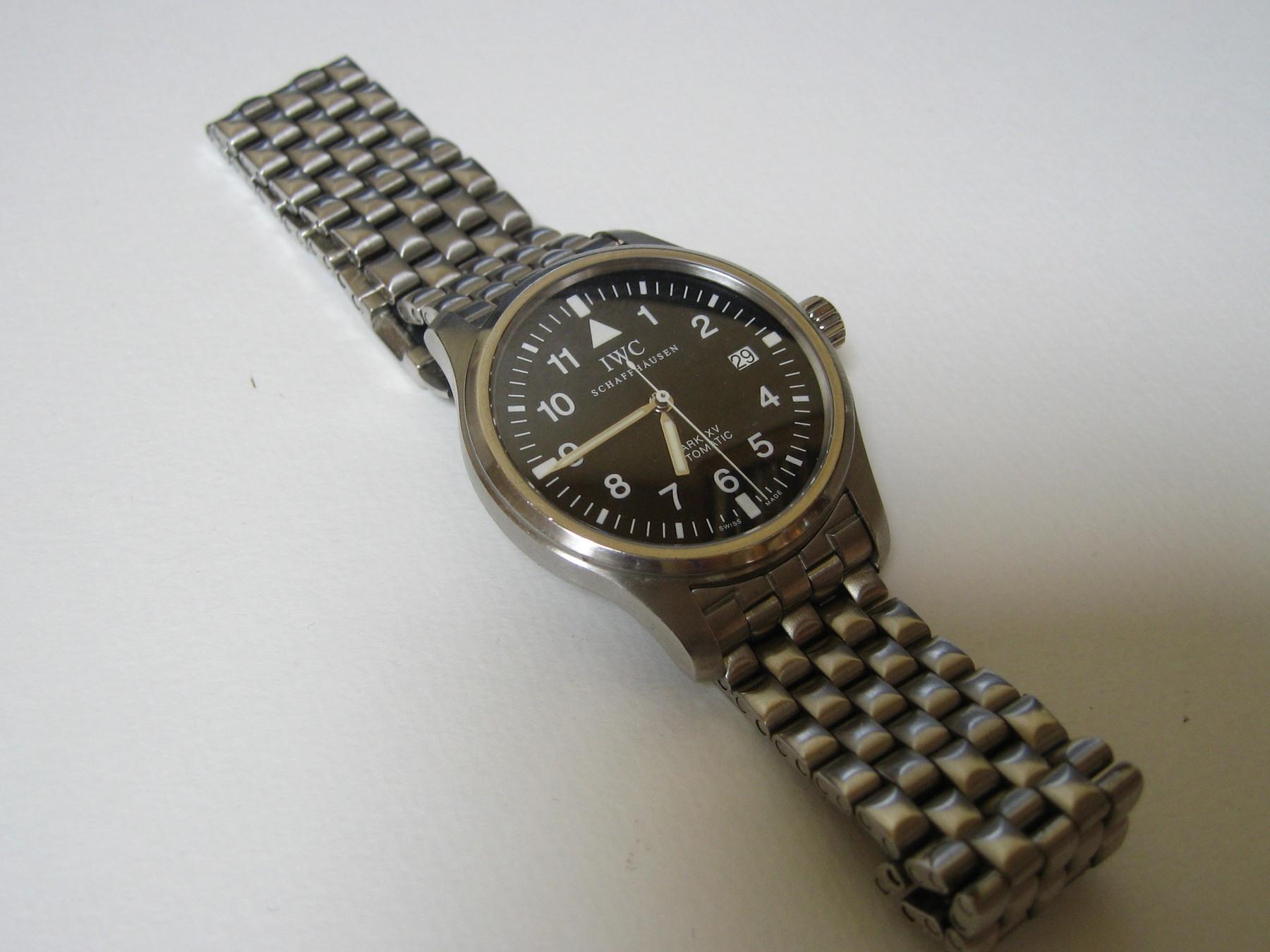
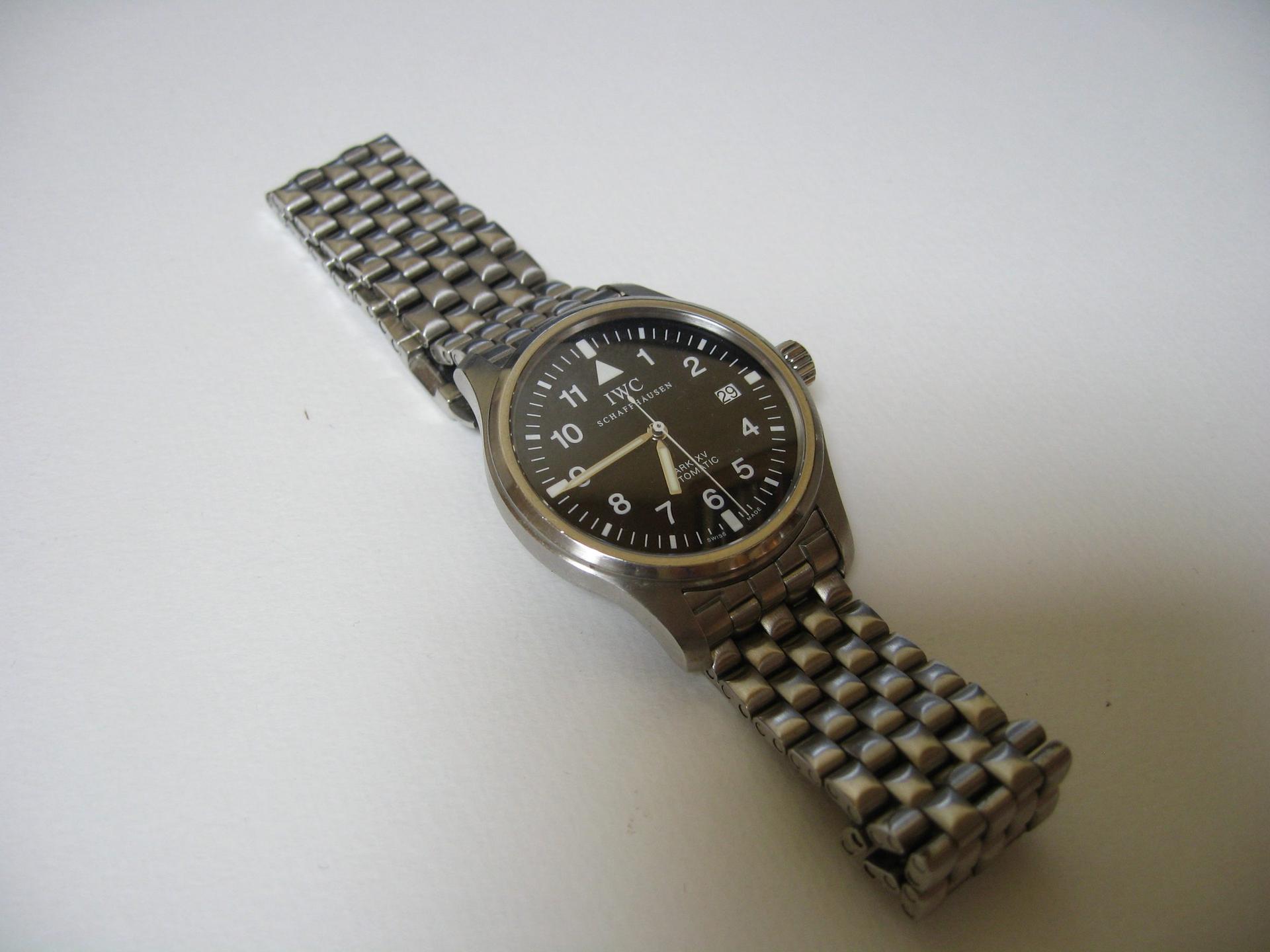
IWC Schaffhausen Mark XV Pilot's Watch on a steel bracelet.

IWC Schaffhausen

Browse listings

An American founded IWC. The engineering stayed Swiss; the accent didn't.

IWC Schaffhausen is a Swiss watchmaker founded in 1868 on the Rhine river in eastern Switzerland. Known for Pilot's Watches (Mark XI lineage), the Portugieser, and the Pellaton winding system.

From
$26,750
lowest current ask
Active listings
1

IWC Schaffhausen history

IWC was founded in 1868 by Florentine Ariosto Jones, an American watchmaker from Boston who relocated to Switzerland with the goal of combining American manufacturing methods with Swiss watchmaking skills. He chose Schaffhausen, in eastern German-speaking Switzerland on the Rhine river, both for cheap hydroelectric power (the Rhine Falls) and for the absence of an established Swiss watchmaking guild that would have restricted his industrial ambitions. The name 'International Watch Company' was deliberate: Jones intended to sell American-made watches to the European market and Swiss-engineered watches to the American market.

The Pilot's Watch lineage began in 1936 with the Special Pilot's Watch reference 325, designed for civilian aviation. The brand's defining military reference is the Mark XI of 1948, supplied to the British Royal Air Force and other Commonwealth navigators for navigation accuracy in jet-age aircraft. The Mark XI carried IWC's caliber 89 movement, central seconds, and a soft-iron inner case to shield the movement from magnetic fields. The Mark XI design language (matte black dial, 36mm steel case, leaf hands) continues through the current Pilot's Mark XX reference IW328202.

Albert Pellaton, IWC's chief watchmaker from 1944 to 1966, patented the Pellaton winding system in 1950. The mechanism uses a swing-mounted automatic rotor and a pawl-and-cam coupling that winds the mainspring in both rotational directions with extremely low friction. Pellaton winding remains a key technical signature of modern IWC movements (calibers 51000, 52000, 82000) and is the longest-lived automatic-winding system in continuous production from any major Swiss watchmaker.

The Portugieser arrived in 1939 as a custom request from two Portuguese watch dealers for a wristwatch with marine-chronometer accuracy and a large dial for instrument-grade legibility. The original Portugieser used a Lépine pocket-watch movement cased in steel, with Arabic numerals, leaf hands, and a railway-track minute scale. The current Portugieser Automatic 42, reference IW501701, maintains the same essential proportions and dial layout in a 42.4mm case with the in-house caliber 52011 movement and 7-day power reserve.

IWC Schaffhausen icons

IWC Mark XV Pilot's Watch with matte black dial, central seconds, and white triangle at 12.

Pilot's Mark XX

Ref. IW328201

The current direct-descendant of the 1948 RAF Mark XI. 40mm steel case, matte black dial, leaf hands, central seconds, soft-iron inner case for magnetic resistance. Caliber 32111 automatic movement, 120-hour power reserve.

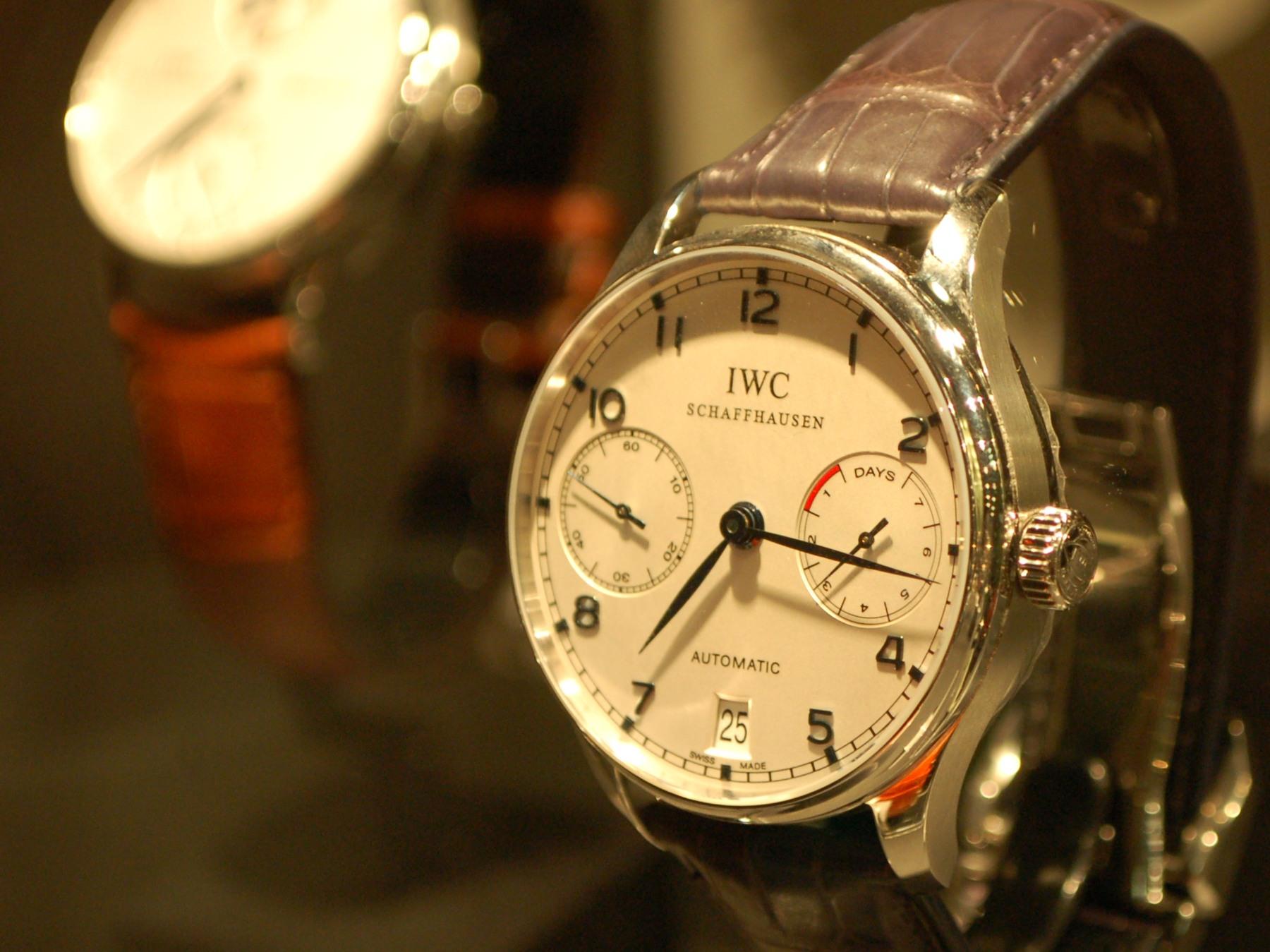
IWC Portugieser Automatic 42 mm with white dial, Arabic numerals, leaf hands, and railway-track minute scale, full case visible with the crown and lugs.

Portugieser Automatic 42

Ref. IW501701

The flagship Portugieser dress reference. 42.4mm steel case, silver-plated dial with Arabic numerals and railway-track minute scale, caliber 52011 automatic movement with Pellaton winding and 7-day power reserve.

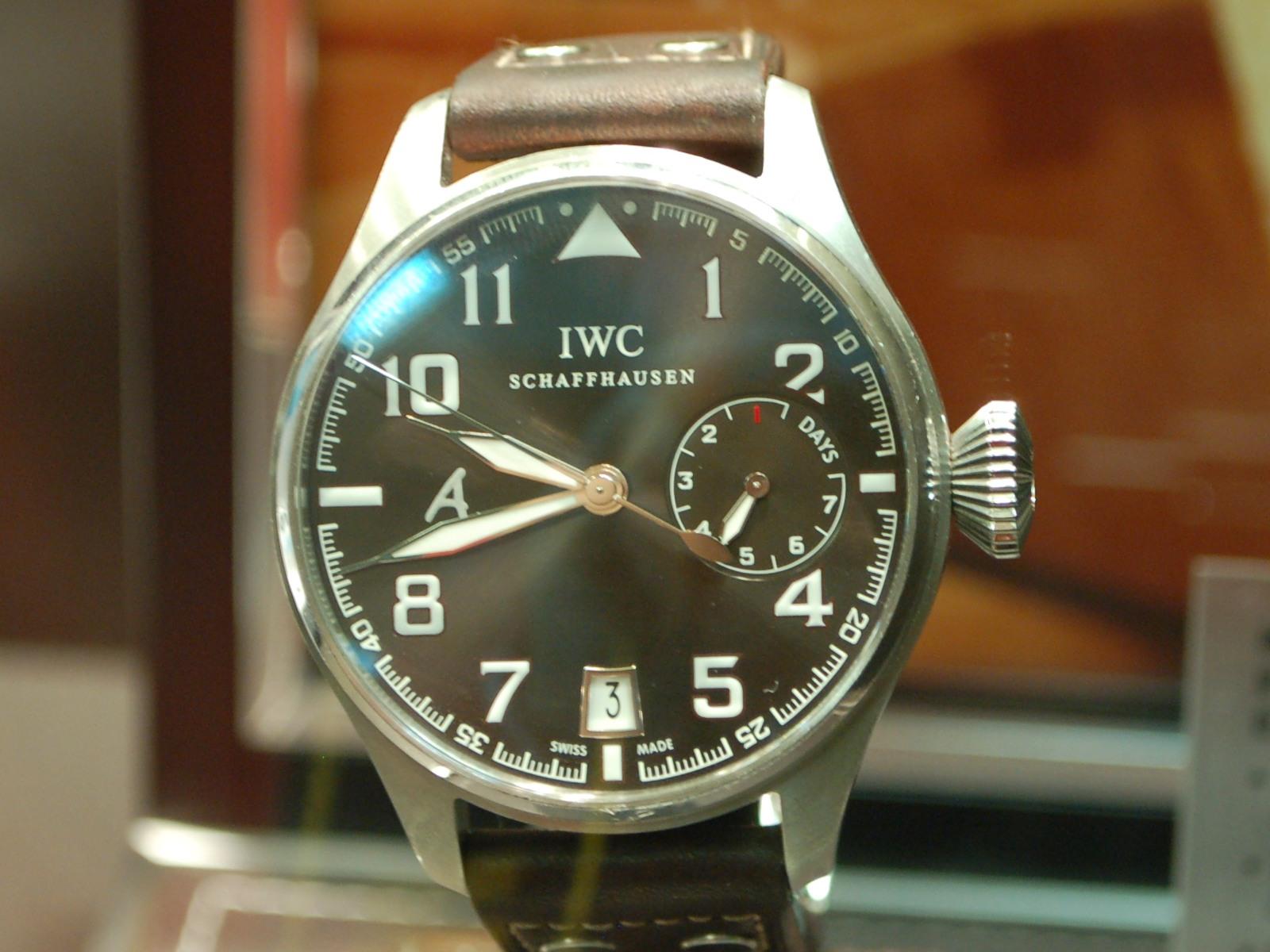
IWC Big Pilot's Watch Saint-Exupéry Edition with dark sunburst dial, oversized onion crown, and cathedral hands, full case visible with the strap lugs.

Big Pilot's Watch 43

Ref. IW329301

The 43mm steel descendant of the 1940 reference 431 Beobachtungsuhr observation watch. Onion crown, oversized cathedral hands, central seconds, caliber 82100 automatic movement with Pellaton winding and 60-hour power reserve.

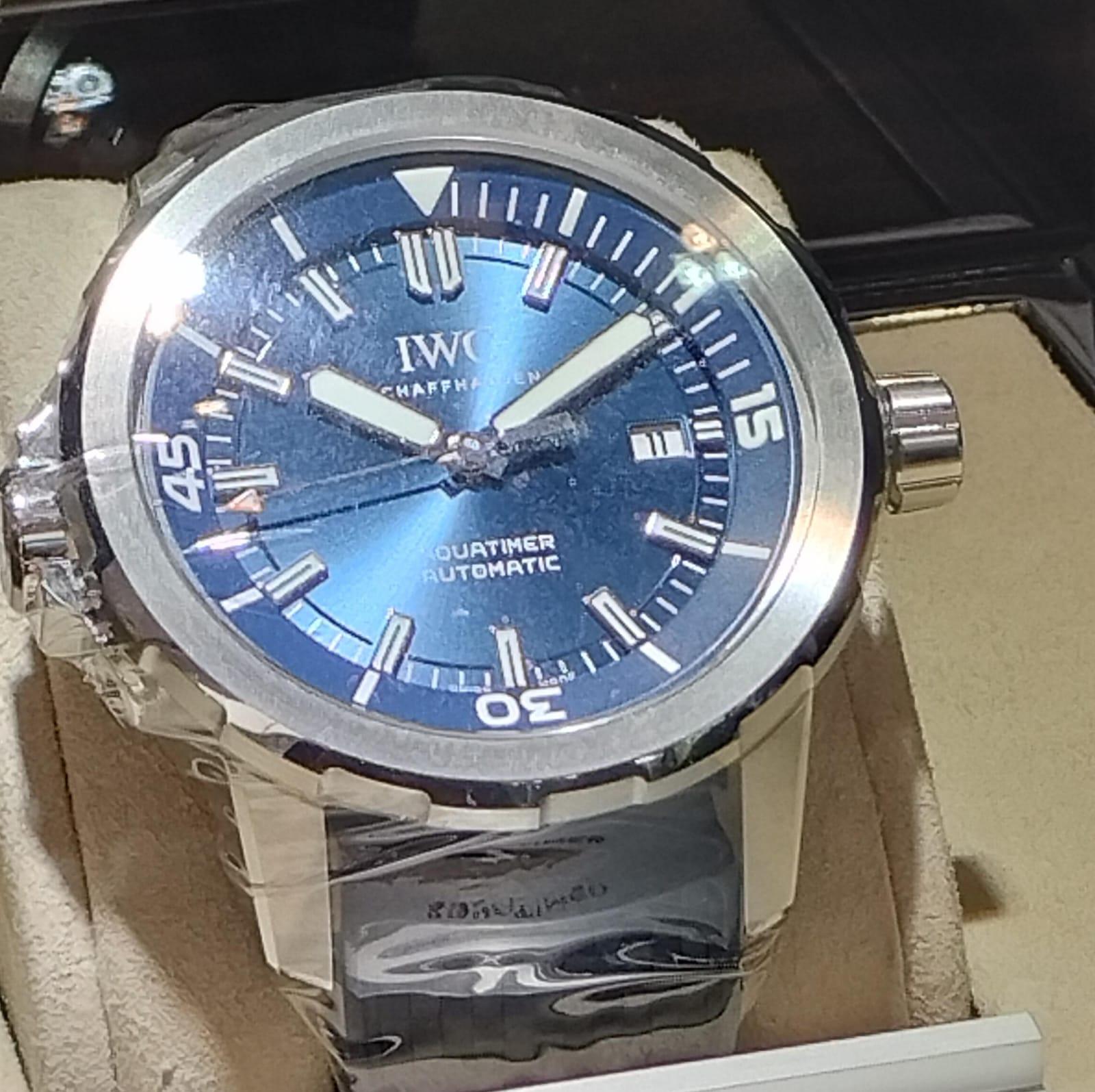
IWC Aquatimer reference IW328801 with blue dial, internal rotating bezel, and date window at 3 o'clock.

Aquatimer Automatic 42

Ref. IW328803

IWC's dive watch line, with the brand's signature SafeDive bezel system (internal rotating bezel coupled to an external locking mechanism). 42mm steel case, 300-meter water resistance, 5-day caliber 32111 automatic movement.

Available now

Common questions about IWC Schaffhausen

What is the IWC Pellaton winding system?
The Pellaton winding system is an automatic winding mechanism patented in 1950 by Albert Pellaton, IWC's chief watchmaker from 1944 to 1966. It uses a swing-mounted central rotor coupled to two pawls and a cam-cut wheel; rotation in either direction winds the mainspring through alternating pawl engagement. The friction in the winding chain is significantly lower than conventional reversing-wheel automatics, which allows the system to extract more energy per rotor swing and contributes to IWC's signature long power reserves (7 days on the caliber 52011 of the Portugieser Automatic 42). Pellaton winding has been in continuous production from IWC since 1950, making it the longest-running automatic winding system from any major Swiss manufacturer. IWC first made the winding parts in zirconium oxide ceramic instead of copper beryllium in 2009, and the current caliber 52000 family carries the pawls and winding wheel in black ceramic, which makes the system practically wear-free.
What is the IWC Pilot's Watch lineage?
IWC's Pilot's Watch lineage began in 1936 with the Special Pilot's Watch reference 325 for civilian aviation, but the defining reference is the Mark XI of 1948, supplied to the British Royal Air Force and Commonwealth navigators as the official navigator's watch. The Mark XI carried caliber 89 with central seconds, a soft-iron inner case against magnetic fields, and a 36mm matte-black case designed for cockpit instrument-grade legibility. The current Mark XX (reference IW328201) maintains the same essential design language in a 40mm case. The Big Pilot's Watch line descends from a separate 1940 IWC reference, the 431 Beobachtungsuhr (observation watch), made for the Luftwaffe with a 55mm case; the modern Big Pilot 43 (IW329301) preserves the onion crown, oversized cathedral hands, and central seconds of the original at 43mm.
How much does an IWC Pilot's Watch cost at retail?
IWC US retail prices for the Pilot's Watch family run from 5,900 USD for the Pilot's Mark XX 40mm on a leather strap (IW328201) as of October 2026, to 10,000 USD for the steel Big Pilot's Watch 43 (IW329301), up from 9,700 USD before IWC's September increase. The dressier Portugieser Automatic 42 (IW501701) is 14,400 USD. The gold-only Portugieser Perpetual Calendar 44 with its double moonphase starts at 59,000 USD. High-complication IWC references (Tourbillon, Portugieser Sidérale Scafusia) exceed 100,000 USD. IWC sits in the same price band as Omega complications and Cartier mid-tier mechanical references. Verify current pricing with an authorized dealer or the IWC website directly.
What does IWC stand for?
IWC stands for International Watch Company. The name was chosen deliberately by the founder, the American watchmaker Florentine Ariosto Jones, who set up the company in Schaffhausen in 1868 intending to sell American-made watches into Europe and Swiss-engineered watches into the American market. The dials of most modern references read 'IWC Schaffhausen' rather than the full International Watch Company name, but the two refer to the same manufacturer.
Why is IWC called IWC Schaffhausen, and what does Schaffhausen mean?
Schaffhausen is the Swiss town where IWC has been headquartered since its founding in 1868, and where it still designs and manufactures its watches. It sits in German-speaking eastern Switzerland on the Rhine river, which makes IWC unusual among major Swiss watchmakers, most of which are clustered in the French-speaking Jura and around Geneva. Jones chose Schaffhausen for its cheap hydroelectric power from the Rhine Falls and the absence of a restrictive local watchmaking guild. IWC adopted 'Schaffhausen' as part of its brand identity to signal that single-site manufacturing heritage, and it appears on the dial of current references.
Where are IWC watches made?
IWC watches are made in Schaffhausen, Switzerland, where the company has operated since 1868. IWC is a manufacture, meaning it designs and produces movements in-house, including the caliber 32000 family used in the Pilot's Mark XX and the Pellaton-wound caliber 52000 and 82000 families. Case finishing, dial work, and final assembly are carried out at the Schaffhausen manufacturing center, so the brand's signature movements and final assembly are Schaffhausen-based.
What is IWC Schaffhausen known for?
IWC is known above all for its Pilot's Watches, the lineage running from the 1936 Special Pilot's Watch and the 1948 Mark XI navigator's watch supplied to the British Royal Air Force through to the current Mark XX and the oversized Big Pilot. Its other defining line is the Portugieser, a 1939 marine-chronometer-derived dress watch. Technically the brand is associated with the Pellaton automatic winding system (patented by IWC in 1950 and still in production), long power reserves, and an engineering-led design language that favors legibility and robustness over ornamentation. IWC is a high-end Swiss manufacture, part of the Richemont group, positioned in the same tier as Jaeger-LeCoultre and the upper end of Omega.

Sources

Image credits