Cartier was founded in 1847 in Paris by Louis-François Cartier, who took over the workshop of his master Adolphe Picard. The maison expanded internationally under his three grandsons, Louis, Pierre, and Jacques, who established branches in London (1902), New York (1909), and serviced royal courts across Europe. King Edward VII of England commissioned 27 Cartier tiaras for his coronation and famously called Cartier 'the jeweler of kings, the king of jewelers.'
The Santos arrived in 1904, designed by Louis Cartier for his aviator friend Alberto Santos-Dumont, who had complained that pulling a pocket watch from his coat while piloting was impractical. The flat square case with exposed bezel screws was the first wristwatch designed for a man, predating the Rolex Submariner and Omega Speedmaster by roughly half a century. The Santos remained in continuous production through 2026 across multiple generations of the design.
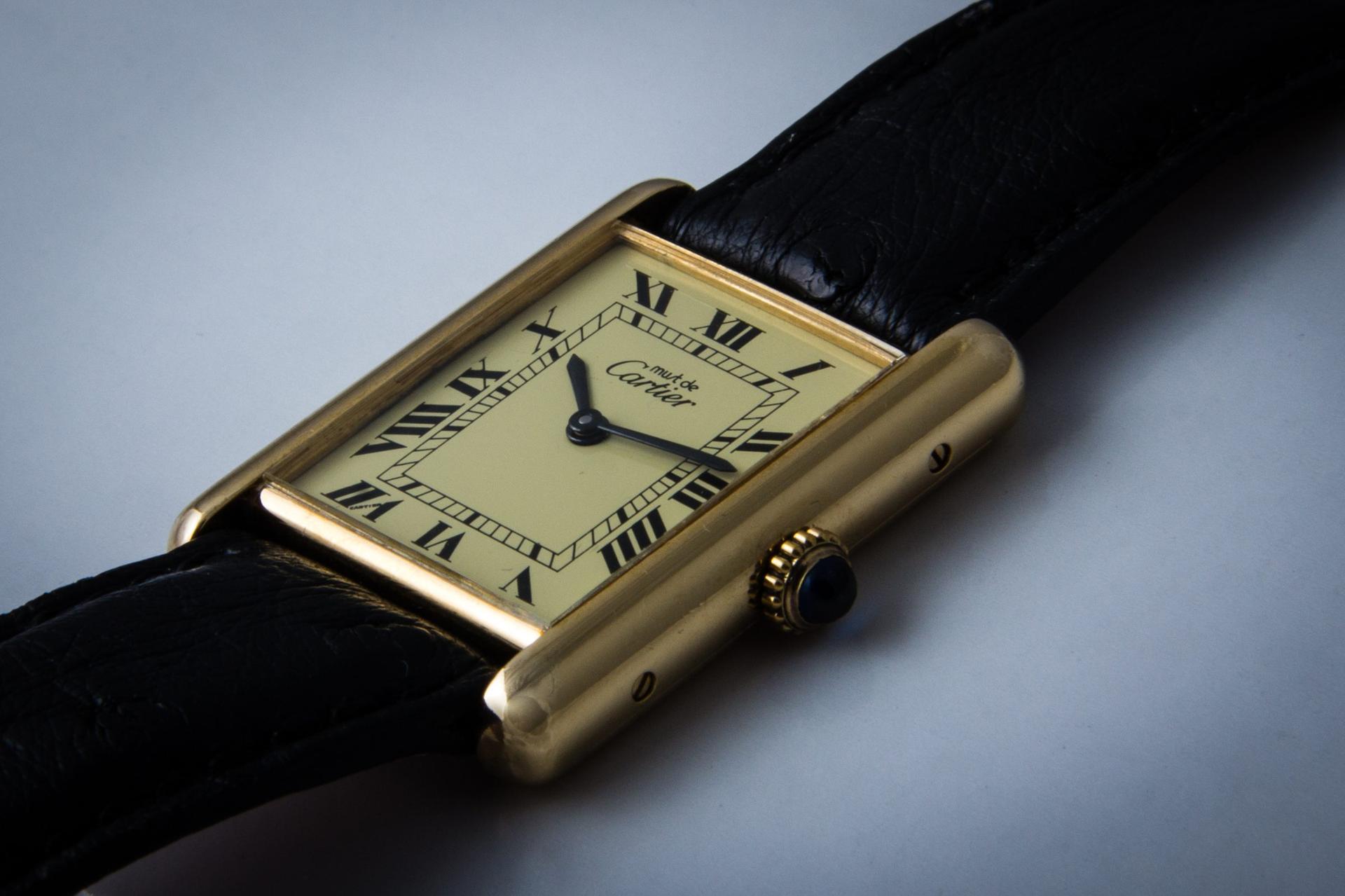
The Tank followed in 1917, designed by Louis Cartier with case proportions said to be inspired by the silhouette of the Renault FT light tanks of the First World War as seen from above. The first commercial Tanks shipped in 1919 and the design has continuously evolved across variants (Tank Louis Cartier, Tank Américaine, Tank Française, Tank Must, Tank Solo). The 2017 centenary celebration cemented the Tank as one of the most-collected watch designs of the 20th century.
Cartier joined the Compagnie Financière Richemont group in 1999 and remains its single largest brand by revenue. The Manufacture Cartier in La Chaux-de-Fonds, Switzerland, produces in-house movements (the caliber 1904 MC family, derived from a 1904 reference number to honor the Santos centenary) alongside outsourced ETA-based movements in entry references like the Tank Must quartz.
Two episodes outside the main Tank and Santos lineages define Cartier's collector-cult reputation. The Cartier Crash, designed in 1967 at the Cartier London branch, was inspired (per the Cartier London archives and the long-standing Cartier-collector folklore) by either a damaged Cartier Baignoire watch returned for repair after a car accident or by Salvador Dalí's melted clocks, depending on which version the source prefers. Original 1967-69 London Crashes total roughly two dozen examples and trade above 500,000 USD at auction when they appear; the modern Crash reissues from 1991, 2015, and 2024 are produced in small batches and remain among the most-followed Cartier secondary-market references. The Pebble of 1972, designed by Jean-Jacques Cartier with a circular dial inside a deliberately mis-shaped case, was produced in similar low volumes and has acquired comparable cult status. Both references show Cartier's willingness to break from the brancard-and-Roman-numeral template the Tank made famous, and both reward collectors who specifically seek non-canonical Cartier design language.
Cartier is sometimes searched online as Carta watches or Carta wristwatches, particularly by buyers new to the brand who encounter the name through gift contexts or jewelry rather than through watch collecting. The brand name is Cartier (pronounced car-tee-ay in French and car-tee-er in English), founded by Louis-François Cartier in 1847 Paris. There is no Cartier-affiliated brand or model called Carta; the spelling is a phonetic approximation. Buyers searching for Cartier references should use the Cartier spelling on resale platforms and the official cartier.com site for the canonical catalog. Items listed under non-Cartier names are not part of the maison's catalog regardless of how they are presented.