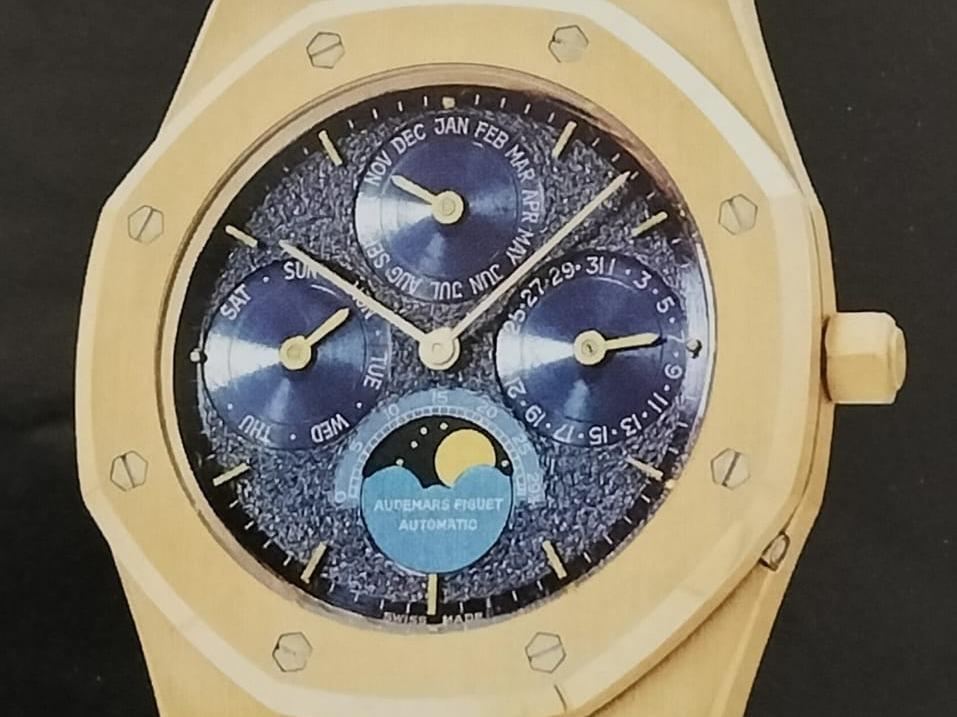
Audemars Piguet perpetual-calendar wristwatch in yellow gold, with day, date, month and moonphase sub-dials.

Audemars Piguet

Browse listings

Designed the Royal Oak in a single night. The sketch never changed.

Audemars Piguet is a Swiss manufacturer founded in 1875, based in the Vallée de Joux. Known for the Royal Oak (1972, Gérald Genta), Royal Oak Offshore, and Code 11.59.

From
$15,900
lowest current ask
Active listings
9

Audemars Piguet history

Audemars Piguet was founded in 1875 by Jules-Louis Audemars and Edward-Auguste Piguet in the village of Le Brassus, in the Vallée de Joux, a region of the Swiss Jura that has been the heartland of haute horlogerie since the 18th century. The two founders, both watchmakers in their early twenties, focused from the start on complicated movements: minute repeaters, perpetual calendars, and the world's smallest movement at the time, the caliber RR. Both founding families still hold ownership stakes today, making Audemars Piguet one of the few haute horlogerie brands that has never left family hands.

The 20th century was a long stretch of complicated-movement specialization punctuated by financial difficulty. AP produced the world's first wristwatch perpetual calendar in 1925, the first skeletonized pocket watch in 1934, and the thinnest manual-wind movement of its era. The brand survived the Depression and the quartz crisis by combining low production volumes with a willingness to produce on-demand grand complications for collectors who commissioned them privately.

The Royal Oak arrived in 1972 and changed watchmaking. Designed by Gérald Genta in a single overnight sketch session before the Basel watch fair, the Royal Oak was the first luxury sports watch in stainless steel priced above contemporary gold dress watches. The octagonal bezel with eight exposed hexagonal screws, integrated bracelet, and Tapisserie-pattern dial broke every Swiss watchmaking convention of the era. Initial sales were slow and AP nearly abandoned the design; by the 1980s the Royal Oak was the brand's commercial backbone, and by the 2010s it had become the most demanded steel watch alongside the Patek Philippe Nautilus.

The Royal Oak Offshore launched in 1993 as a larger, more rugged interpretation of the original. The Code 11.59 line, introduced in 2019, was AP's attempt to refresh its catalog beyond the Royal Oak; market reception has been mixed, with collectors continuing to weight Royal Oak demand above any other reference in the brand's catalog.

Audemars Piguet icons

Audemars Piguet Royal Oak Jumbo reference 15202 in stainless steel, worn on the wrist, showing the blue Tapisserie dial, octagonal bezel with eight hexagonal screws, and integrated bracelet.

Royal Oak Selfwinding

Ref. 15500ST

The current 41mm steel Royal Oak with date, succeeding the long-running 15400ST in 2019. Caliber 4302 self-winding movement, 50-hour power reserve, signature 'Grande Tapisserie' dial pattern. The most-collected stainless-steel reference in the AP catalog.

Audemars Piguet Royal Oak Offshore Chronograph in stainless steel, showing the white Mega Tapisserie dial, tachymeter scale, three chronograph sub-dials, and oversized octagonal bezel screws.

Royal Oak Offshore Chronograph

Ref. 26238ST

The 42mm rubber-bezel Offshore chronograph, evolution of the 1993 original. Caliber 4404 in-house integrated chronograph movement (replacing the long-running Frédéric Piguet-based caliber 3126/3840) with column wheel and flyback function.

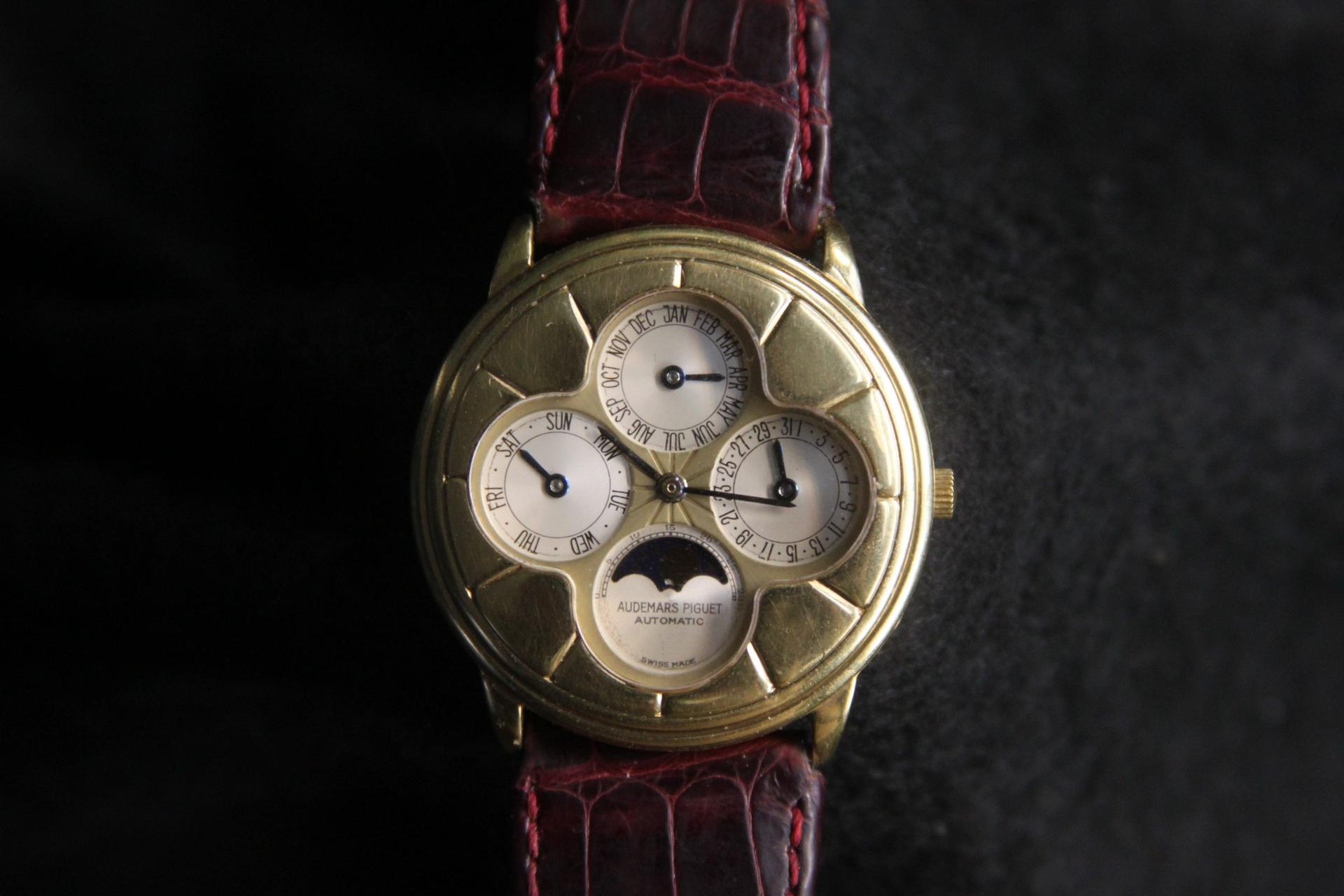
Audemars Piguet Royal Oak perpetual calendar in yellow gold from the mid-1990s, with day, month and date sub-dials and a moonphase display on a blue dial.

Royal Oak Perpetual Calendar

Ref. 26574ST

The 41mm steel Royal Oak with perpetual calendar, leap-year, and moonphase complications on a single dial. Caliber 5134 self-winding movement, 40-hour power reserve. One of the few perpetual calendars in steel from any major manufacturer.

Audemars Piguet Code 11.59 Chronograph reference 26393 in white gold, with a blue lacquered dial, three sub-dials, and the collection's round bezel over an octagonal middle case.

Code 11.59 Selfwinding

Ref. 15210BC

The 41mm white-gold Code 11.59 introduced in 2019 as AP's non-Royal-Oak design direction. Octagonal middle case with sapphire crystal curved on both sides, lugs hidden under the case, caliber 4302 self-winding movement.

Available now

How to authenticate an Audemars Piguet Royal Oak

The Royal Oak is the most-faked AP reference because of its design recognition and steel-luxury pricing power. The steps below focus on the Royal Oak Selfwinding line (15400ST and 15500ST families); Royal Oak Offshore and complicated Royal Oak references add their own checks that an AP-marque specialist should verify.

  1. Check the octagonal bezel screw alignment

    Genuine Royal Oak bezels carry eight white-gold hexagonal screws (yes, hexagonal screws on an octagonal bezel) whose slots are individually aligned at the factory to point in the same direction (typically toward the center of the dial). Misaligned screws, round-head screws, or any screw type other than hexagonal are immediate fake signals.

  2. Inspect the Tapisserie dial pattern

    The Royal Oak dial uses one of three Tapisserie waffle patterns: Petite (vintage), Grande (15300/15400/15500), or Mega (Royal Oak Offshore). Under 10x magnification, the squares should be sharp and uniform with consistent depth across the dial. Blurry or shallow Tapisserie, inconsistent square sizes, or a printed dial that simulates the pattern are all fake signals.

  3. Verify the case-finish transitions

    AP polishes the bezel chamfers by hand against alternating brushed surfaces on the bezel top and case sides. The transitions between brushed and polished should be perfectly sharp under a loupe; counterfeits show smeared or rounded transitions. The bracelet links carry the same alternating brushed/polished finish; check the inside surfaces of the bracelet links, which are often left rough on fakes to save labor.

  4. Open the case-back and verify the movement

    Modern Royal Oak Selfwinding references use the caliber 3120 (15300, 15400) or 4302 (15500). The movement is visible through a sapphire case-back on most modern references. The rotor should carry the Audemars Piguet logo and family crest in deep engraving; the bridges should show Côtes de Genève striping with no machining marks. A solid (non-display) case-back on a modern selfwinding Royal Oak is suspect.

  5. Confirm the serial and reference engravings

    Royal Oak serial numbers are engraved on the case-back outer rim with a consistent font depth. The reference number sits on the inner case-back. Both engravings should be sharp and pin-deep; AP uses laser etching, which produces a cleaner edge than the rotary engraving favored by counterfeiters. Cross-reference the serial against the AP Customer Service portal (subscription required) or with an authorized dealer.

  6. Send to AP service or a third-party authenticator

    Audemars Piguet authorized service centers in Le Brassus, New York, Geneva, and Tokyo authenticate and service every reference. Independent services (WatchCSA, Beckertime, Real Authentication) authenticate Royal Oaks for 150 to 400 USD as of 2026-05-27. AP's own service offers an authentication certificate at no charge on watches sent in for routine service.

Last reviewed by Enthuster editorial · May 27, 2026

Common questions about Audemars Piguet

How do you authenticate an Audemars Piguet Royal Oak?
Royal Oak authentication is a multi-step inspection focused on the octagonal bezel screws (hexagonal heads, factory-aligned slots), the Tapisserie dial pattern (sharp uniform squares under 10x magnification), the alternating brushed/polished case finish (sharp transitions, not smeared), and the movement (caliber 3120 or 4302 visible through sapphire case-back, with deep AP-logo rotor engraving). Modern references should never have a solid case-back. For purchases outside a trusted dealer, send the watch to an AP authorized service center or an independent authenticator (WatchCSA, Beckertime, Real Authentication) before final payment. Independent authentication for a Royal Oak typically costs 150 to 400 USD as of 2026-05-27; verify current pricing with the service directly.
How much does an Audemars Piguet Royal Oak cost at retail?
US retail starts at $31,900 for the Royal Oak Selfwinding 41 mm in stainless steel (15510ST) and $40,100 for the 39 mm Jumbo Extra-Thin (16202ST), verified against audemarspiguet.com in July 2026. The steel Selfwinding Chronograph 41 mm (26240ST) lists at $44,400, the same chronograph in pink gold (26240OR) at $93,400, and the steel Perpetual Calendar (26574ST) at $124,200. Openworked and double-balance references run higher. Those numbers are what an allocated client pays; a walk-in buyer with no AP purchase history will not be offered a steel reference at those prices, and the secondary market runs well above them. The Royal Oak page carries the reference-by-reference retail and pre-owned figures with their verification dates.
Why is the Royal Oak considered iconic in watchmaking?
The Royal Oak is considered iconic because it created an entire category in 1972: the luxury sports watch in stainless steel, priced above contemporary gold dress watches. Designed by Gérald Genta in an overnight sketch session before a Basel trade-show deadline, the watch broke every Swiss watchmaking convention of the era, with exposed bezel screws, an integrated bracelet, and a water-resistant steel case marketed at a price reserved for precious metals. Initial sales were slow and AP nearly killed the design. By the 1990s and especially the 2010s the Royal Oak had become the most demanded steel watch alongside the Patek Philippe Nautilus (also designed by Genta, four years later). Modern collector demand for the Royal Oak Selfwinding 15500ST consistently exceeds retail supply by an order of magnitude, with secondary-market prices running 50 to 80 percent over MSRP through most of the 2020s.
How do you sell an Audemars Piguet watch?
Gather the paperwork first, because it moves the price more than anything you can do to the watch. The original AP warranty card with the matching serial, the box, and a service history from AP are what a buyer pays for; a Royal Oak with full box and papers sells for more and sells faster than the same watch bare. For an inherited piece with no card, AP's own service price list (Geneva, taxes excluded, as of October 2026) offers an extract from the archives for 500 CHF and a certificate of authentication, after inspection in Le Brassus, for 2,500 CHF. Then pick a channel. Selling to a dealer is the fastest and the lowest number, because the dealer buys at wholesale and needs margin to resell. Consignment gets closer to the market price, but you wait for the sale and give up a cut. Listing it yourself to collectors and dealers keeps the whole price, and that is what Enthuster is for: listing is free for dealers and collectors and you keep 100% of the sale. Price against the live market, not the retail figure; the Royal Oak page carries the current pre-owned figures by reference. Never ship before payment clears.
What does a pre-owned Audemars Piguet cost compared to retail?
More than new, for the steel Royal Oak, which is the reverse of almost every other brand. As of October 2026 a pre-owned Royal Oak Selfwinding 41 mm (15510ST) trades around $47,538 against $31,900 US retail, about 49% over list, and the Jumbo Extra-Thin 16202ST trades around $80,400 against $40,100, about double. The discontinued 36 mm 14790ST, which has no retail price any more, trades around $32,000 for standard dials, so the oldest steel reference on our Royal Oak page is also the cheapest way into the line. The premium exists because AP sells steel Royal Oaks only through its own boutiques, AP Houses and partner-run monobrand boutiques, to clients with purchase history; retail is what an allocated buyer pays after a wait, and the pre-owned price is what everyone else pays. We do not yet publish cited pre-owned figures for the Offshore, the gold references or the complications; get a live dealer quote on those rather than assuming the steel premium carries over. (Source: WatchCharts secondary-market data, cross-checked against dealer asking prices, as of October 2026; retail verified November 2026 against audemarspiguet.com.)
How does the Royal Pop relate to the Royal Oak and the MoonSwatch?
The Royal Pop is Swatch's third major luxury collaboration, following the 2022 Omega MoonSwatch (a Speedmaster reinterpretation in Bioceramic) and the 2023 Blancpain x Swatch Fifty Fathoms. Unlike both prior collaborations, which paired Swatch with sister Swatch Group brands, the Royal Pop is Swatch's first cross-group luxury crossover: Audemars Piguet is independent, owned by the founding families since 1875, with no Swatch Group ownership ties. The Royal Pop reinterprets Audemars Piguet in pocket-watch form, returning to AP's 19th-century pocket-watch heritage rather than the modern Royal Oak wristwatch line. The eight references take their names from the word 'eight' in eight languages (Huit Blanc, Blaue Acht, Ocho Negro, Green Eight, Otto Rosso, Orenji Hachi, Lan Ba, OTG Roz), a nod to the Royal Oak's octagonal bezel with its eight exposed hexagonal screws. The pieces are Swatch products at Swatch pricing (launched at 400 to 420 USD, 415 to 445 USD in the US as of November 2026), not Audemars Piguet timepieces. Audemars Piguet's Royal Oak wristwatch line continues unchanged, with retail Royal Oak Selfwinding references starting around 32,000 USD as of the 2025-2026 catalog.

Sources

Related models

  • The Audemars Piguet x Swatch Royal Pop is the 2026 collaboration: eight Bioceramic pocket watches with Royal Oak design cues at $415 to $445 US retail, sold in-store only.
Image credits